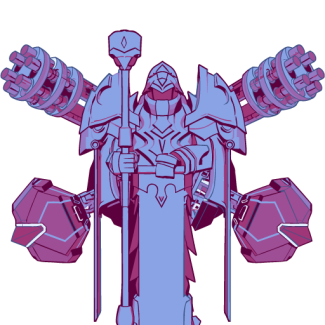
Where there's lanes, there's towers!
Defensive structures are a staple of the genre, yet despite good design intentions, many of them end up with inelegant or confusing mechanics.
We can learn a lot about this problem by retracing the lineage, and learning how and why towers came to be.
Foundations of a Tower
Towers originate from Starcraft, Warcraft III and their RTS gameplay.
Each of the races in these games can create buildings which are stationary and attack enemy forces that approach.
The advantage of defensive buildings is they don't consume food/supply resources, while giving a combat edge in holding territory. They are never a complete solution to defense, as specialised units in the opposing army can out-range or maneuver around them.
Contributing to the depth and identity of each race, defensive buildings tend to have a few upgrades that affect how they support the army:
- Human towers can upgrade to deal area damage, burn mana, or detect invisible units.
- Orc towers can upgrade with damage return to melee attackers, and increased health.
- Undead towers can apply a slow.
- Night Elf towers can uproot and slowly move.
In some cases towers are built offensively, such as the classic "bunker rush" strategy, but in general they guard bases. When a player is losing a lot of towers, their position is worsening (but they can still recover and build more).
Transposing to the Lanes
Lane-pushing games usually offer a different paradigm, where defensive structures are already deployed at the start of a match. They are material that can only leave the field of play over time.
In the first lane-pushing game Aeon of Strife (2002), players are part of an army with a massive base and lots of defensive structures. Every time territory is lost, that is represented at a granular level by destroyed buildings.
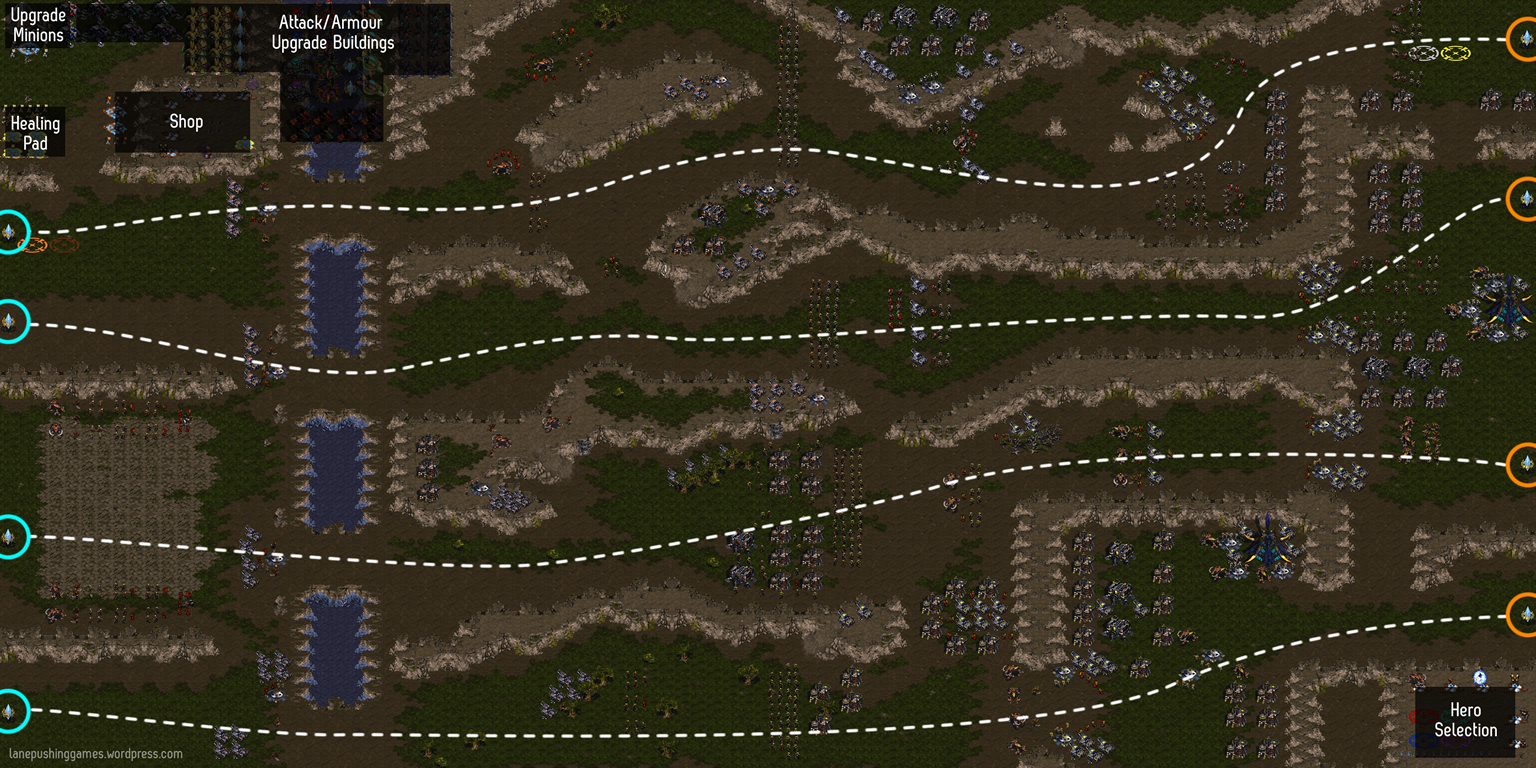
This establishes a core principle: defensive structures are a narrative device.
In the game "pool", we can look at a game in-progress and understand immediately which player is winning and in a favourable position.
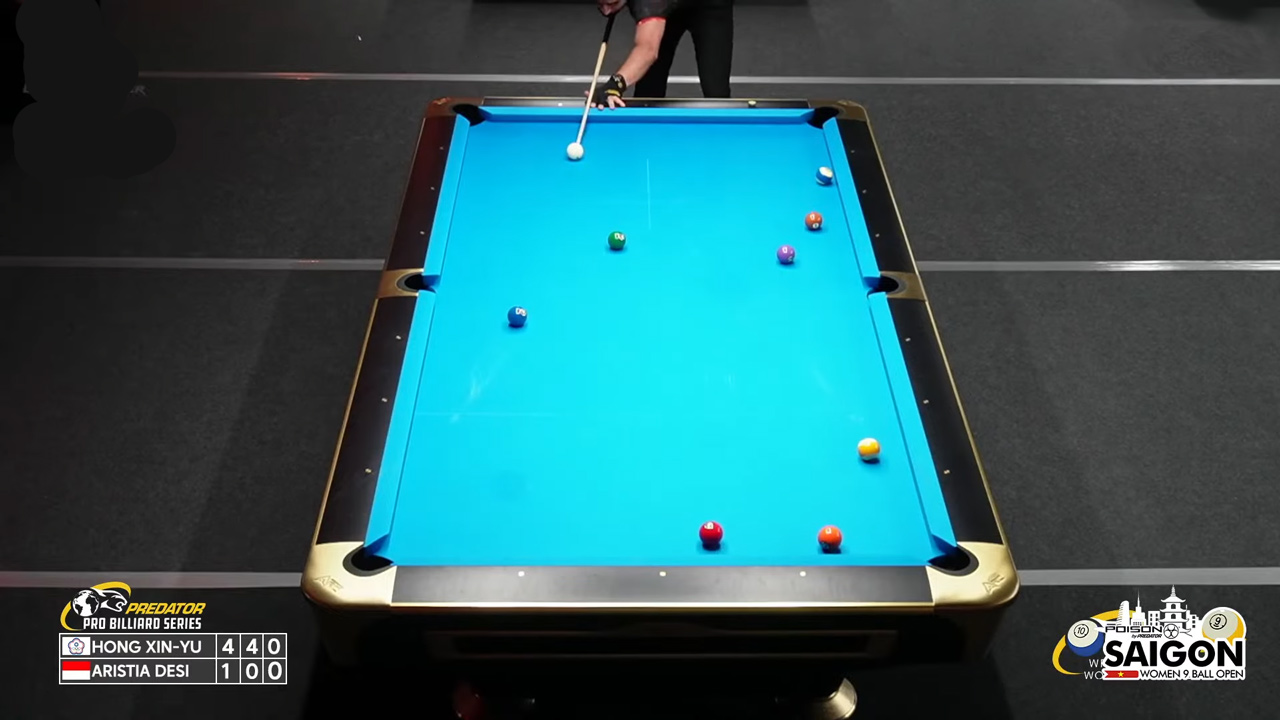
The table tells a story, and in a lane-pushing game the remaining buildings for each team also tell a story.
That is their purpose. Defensive structures which are not milestones or do not represent the narrative victory, risk being wasteful or unsatisfying.
Many Becomes One
By 2003, the genre was exploring a new direction. Instead of having lots of buildings and units scattered across their territory, armies now had isolated towers or "mini-bases", with lots of empty space in-between. Examples include:
- DotA is one of the lineages that leaned into isolated towers.
- Tides of Blood had a mixture of mini-bases and four-tower clusters.
- Eve of the Apocalypse leaned heavily into mini-bases, with both smaller and larger ones.
Let's focus now on the tension between defensive structures and a team that is on the attack. The attacker wants to find an exploit, and that means the defender must have a balanced set of answers in their defense.
For those games which use mini-bases, the balance emerges from the multiple units and structures involved, much as the RTS army has specialised units to respond to each threat.
However, when by design there is a single isolated tower, that tower becomes subject to tower engineering — the practice of fitting several units' capabilities into one building.
A History of Tower Engineering
Our first example is is found in Defense of the Ancients (2003).
The game took basic towers from two races (Night Elves and Undead), and added the ability True Sight (an upgrade allowing Human towers to detect invisible units).
This reflects the absence of Spirit Owls and Shades that would normally contribute this layer of defense in an RTS army. Not only did this protect the towers themselves, it gave players a first layer of safety against invisible opponents.
Not long after, DotA Allstars innovated Backdoor Protection, which exemplifies the role of towers as a narrative device.
Almost every lane-pushing game includes a version of this, because while backdooring is a novel strategy and adds "depth", it is not aligned with narrative victory through pushing lanes. Players dislike when the narrative is circumvented, especially when it creates a sudden and surprise loss.
Lets explore 7 examples, each with something to teach.
Case Studies
League of Legends is a notable one. Its turrets...
- Deal additional damage to enemy players with each attack against an enemy player.
- Have a "plate" system that allows gold bounty to be dispensed in increments.
- When a plate breaks, the turret's armour temporarily increases based on how many enemy players are nearby.
- Have near-invulnerability for the first 5 minutes (but only on 2 lanes).
- Lose armour and resistance over time (tier 1 turrets only).
- Accumulate crystals over time which shatter when attacked by a player, causing damage based on how long since a player last attacked the turret.
In a typical RTS, a unit might have one clock or counter (such as 'energy'). League's turrets have at least six. What is going on here?
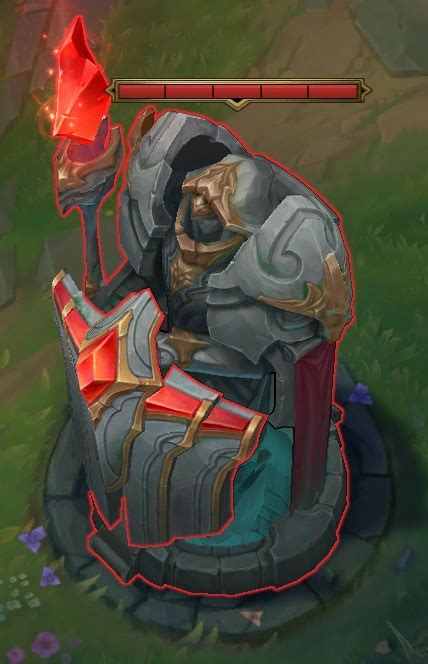
These turrets have not only been engineered with balanced defenses, but also with fine-tuned controls to dictate the pacing of a match.
As a narrative device, turrets are doing their job. It's certainly a big deal when they crumble.
However, making turrets bear a second responsibility, in this case pacing, has piled a lot of mechanisms onto a single unit. Over time, it has resulted in an implementation that is very unintuitive.
When faced with the temptation to make towers bear a second responsibility, I encourage two options. One is to assign responsibility to a different system (in this case, control pacing using other levers), and the other is to divide the responsibility among more units to keep behaviours intuitive and easy to read for players.
Paragon inherited its approach to towers from SMITE and early League. It is of interest here because the engineering spills over into the game UI.
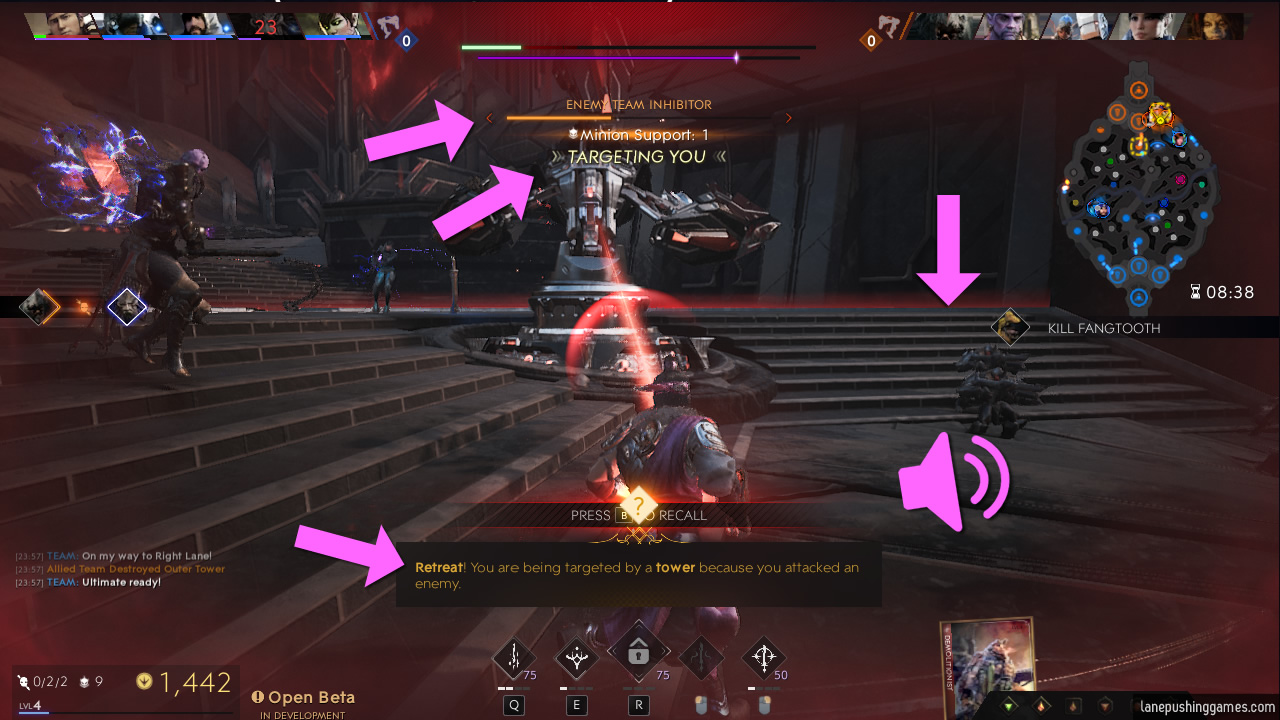
As a third-person camera game, there are at least 5 prompts and signals to help players navigate the threat of being in enemy territory when the camera can't see the tower.
The system is functional, but there is clearly a cost in the form of inelegant UI clutter.
When a mechanic creates this much clutter, I would say it's better to go back to first principles and try a different angle. As a 3D game, Paragon had a novel design space to explore. The implementation of towers is inherited from games which have a top-down camera, and a different approach would likely have yielded better results.
Be careful what you inherit!
Dota 2 has stayed fairly elegant on the surface. Nonetheless, engineering work has been done.
Firstly, many lane-pushing games have a Teleport ability that allows relocating to a friendly structure. This is one of the most important ways that players interact with towers.
When a player uses Teleport on a tower in Dota 2, subsequent Teleports by friendly players to that same tower will take longer to complete. This is a weird exception, and it is a "global" rule that isn't on the tower's stat block.
(Specifically, the channel time is 3/5/5.5/6/6.5 seconds.)
Secondly, Dota 2 has other "global" rules like Backdoor Protection and Fortification. These aren't a trait or ability of a specific unit, but they do affect towers. Notably, effects are different based on the tier of the tower; tier referring to outermost (tier 1) to innermost (tier 4).
Since all tiers of tower are called "towers" and they are visually identical, the most important distinction between tiers (how they behave under the global rules) is not made clear to players.
Essentially, Dota 2's towers are bearing a second responsibility, which is for macro (global mobility, fortification, backdoor protection).
This manifests indirectly through global rules that are documented elsewhere in the game.
I don't disagree with this approach, but I would like to see the visual assets of the towers updated so any building with a Teleport-channel-time-alteration rule has that visually represented, and that tier 1 towers are named and presented differently so it is clear that some global rules don't apply to them.
(Deadlock seems to have learned this lesson; its towers use different names and models for each tier while being clear in their function.)
Eve of the Apocalypse (2003) gives its heroes no Teleport ability at all, and instead each mini-base has a Keep with a Summon Hero ability. This means the cooldown is not tied to the hero, but to the Keep!
Consequently, heroes can only "teleport" in at a rate of 1 every 30 seconds, making a surprise push more difficult to respond to, and team coordination more important.
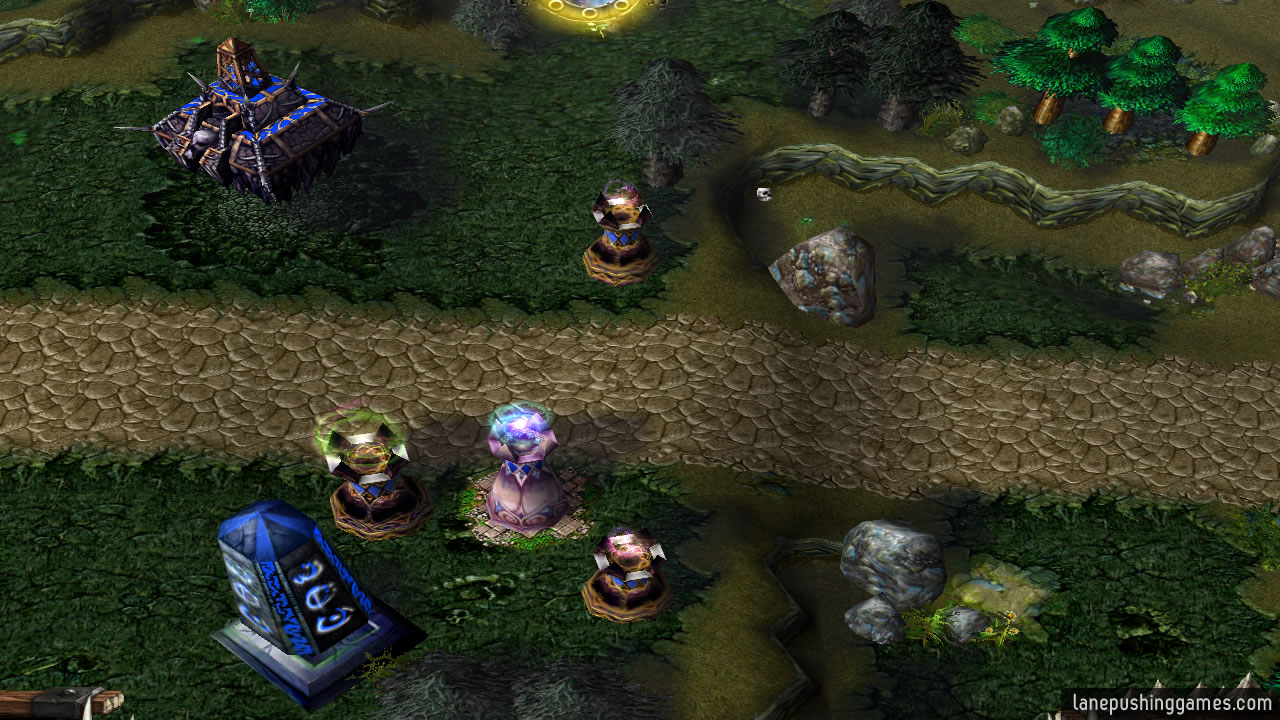
Hands of Sorrow Knight (2006) has towers with multiple simultaneous attacks, including a dedicated attack for heroes, and a dedicated attack for summons.
If there are no heroes or summons nearby, those attacks simply don't fire.
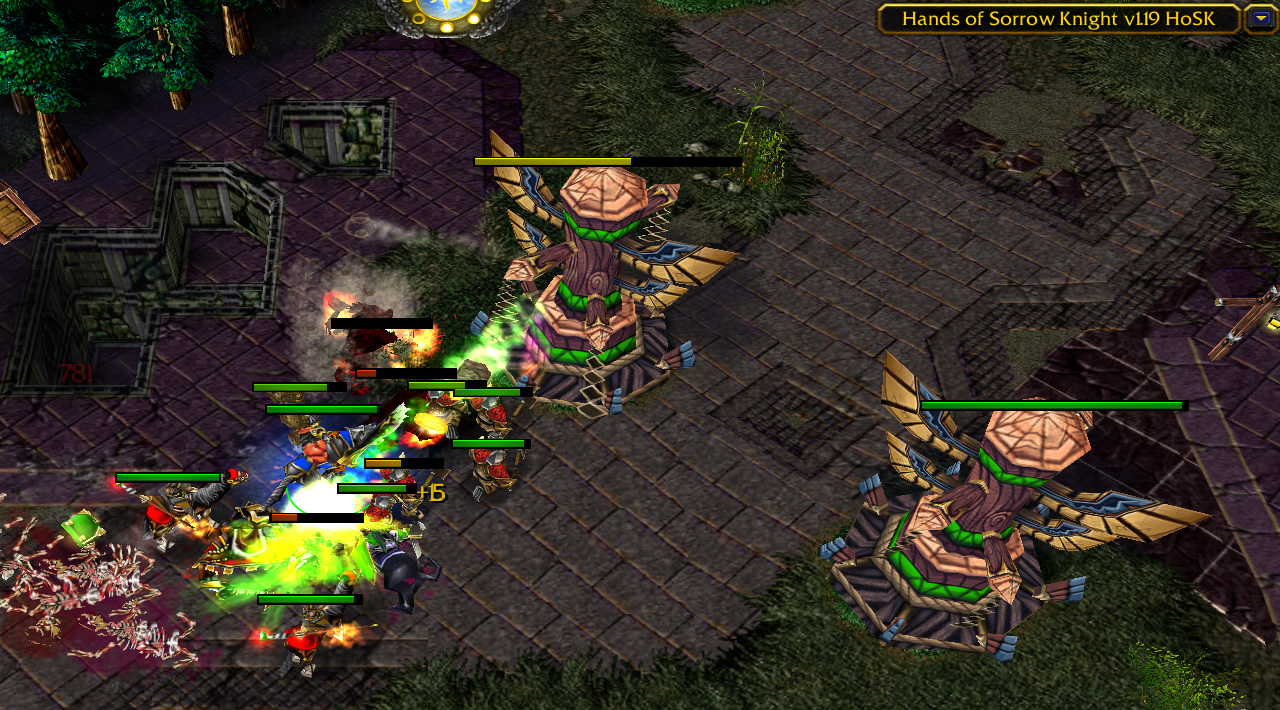
These towers are very predictable and gracefully handle the potentially large amount of summons in that game.
Not only is this a clean solution, the tower attacks are easy for players to view because the towers have an inventory with 6 items, each item representing an attack with a tooltip that players can read!
Heroes of the Storm should be commended for a congruent approach.
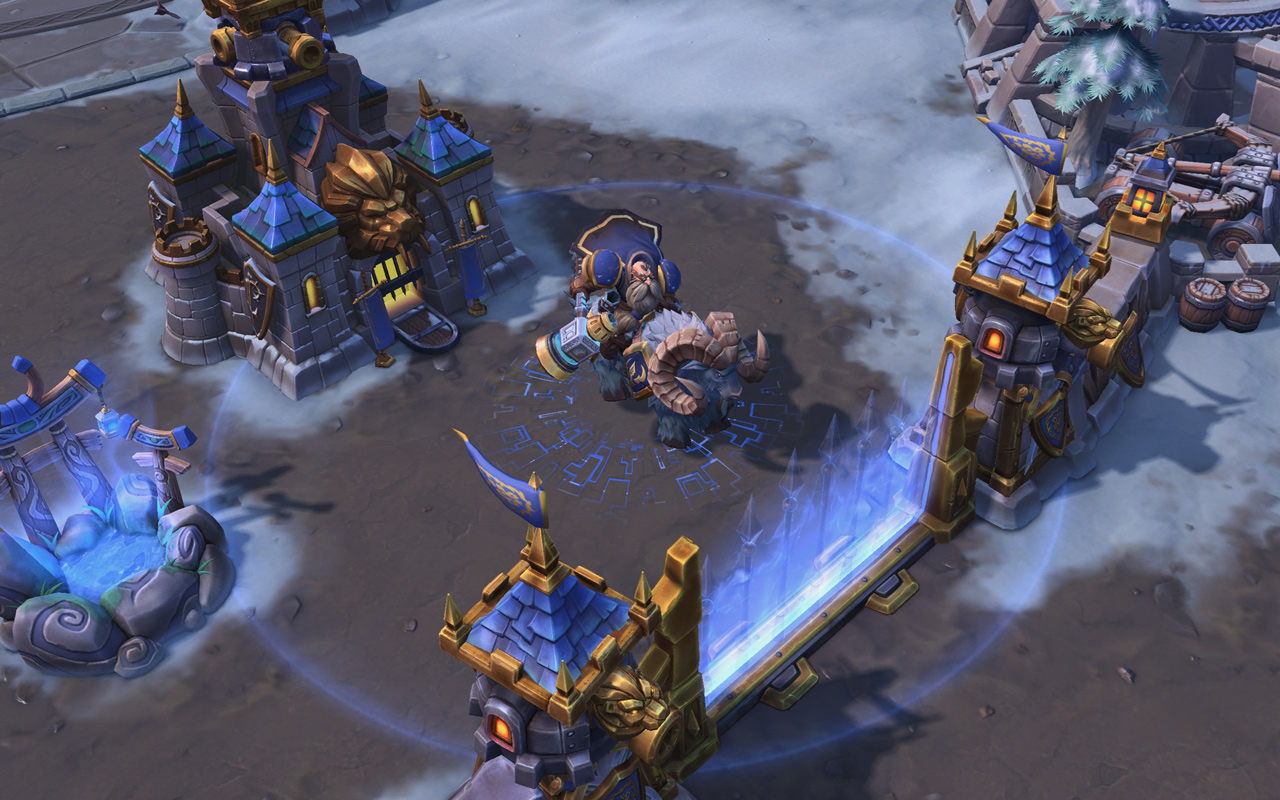
The combination of walls and gates confer an easily understood maneuverability advantage. The towers and forts make it clear where the threat zones are, while a slight slow effect on tower attacks offers a nontrivial teamfight advantage.
The healing well supports pressure on nearby objectives, and the keep being the biggest and last structure to be destroyed feels satisfying. Tower Ammo, while it lasted, offered a clear indication of the benefits of pushing.
Additionally, most hero abilities deal damage to buildings like they damage anything else. Their one-way gates were a technical innovation that was not possible in Warcraft III. League and Dota 2 have adopted them since.
Finally, HotS had a range of maps. The better ones generally had narrative alignment between claiming objectives and destroying forts. (This is a deeper case study to explore another day.)
March of Giants is a game which experiments in this area. The 2025 alpha allowed players to spend team resources to place defensive structures, ranging from trenches to cannons.
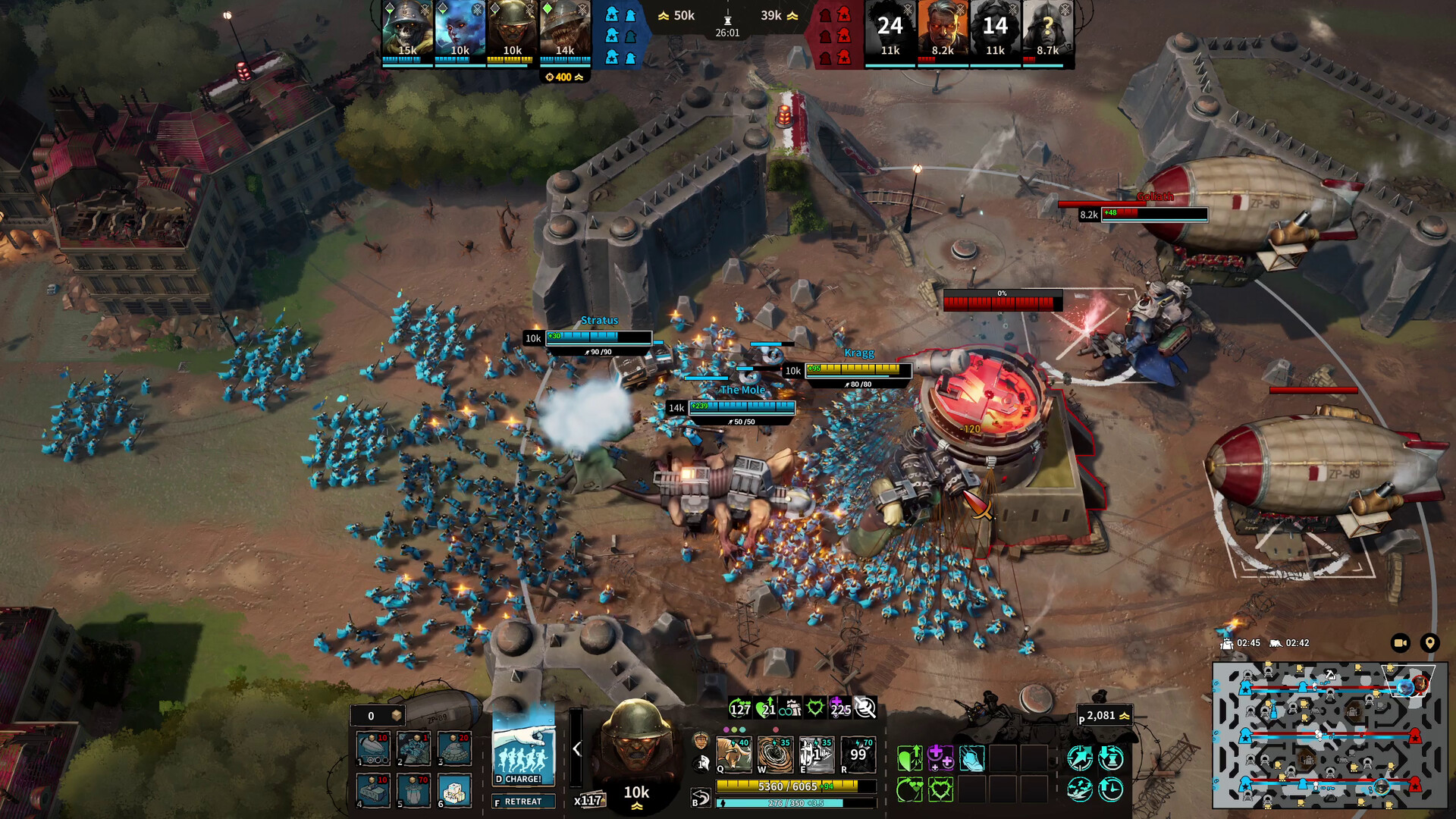
However, I can't overlook one detail. This game is about playing as a literal giant, the biggest and most fearsome force on the battlefield.
When I run into the firing range of a tower, the enemy's biggest gun, the only thing that can reliably harm me... the gun points at infantry, then tanks, and finally prioritises me last. (Unless I target an enemy giant.)
Towers are a narrative device, and this felt like a narrative fumble. I believe a more creative approach to defenses and how players interact with them would do a lot for this game.
Conclusions
Towers bear different responsibilities depending on the game. In an RTS they are a fragment of a larger army, while in lane-pushing games they are a narrative device.
As much as possible, a game should let them fulfill that exact role, and pass other responsibilities to other systems.
Consider:
- How does my player's world expand when destroying a tower?
- How does my player's world contract when losing a tower?
- How does my player feel while inside the threat zone of a friendly/enemy tower?
- Does my player see towers as milestones tied to the narrative victory?
Commercial exploration in this area has been narrow. There is plenty of opportunity to let go of assumptions and design more interesting topologies for defense and attack.
For example, Night Elf and Undead towers happen to use attacks with singular slow-moving projectiles. Through inheritance, games from a DotA lineage have ended up with timing-based tricks, such as dropping tower aggro between attacks, or using abilities to disjoint the projectiles.
If the genre's early towers were based on Sunken Colonies, the instant subterranean attack of that unit simply would not afford this.
I encourage assuming this design space to be very large, and underappreciated in its influence on the overall play experience. In the grand scheme of things, don't discount your towers!


Add new comment